
At the center of Yellowdig is community and at the center of community are the learners. We value the experience and insights from students very highly, which is why we have put a lot of effort into making sure their voices are heard.
Recently in our student panel webinar, we had the opportunity to hear from 4 students with very diverse backgrounds.
In this blog we share:
Anthony, Arizona State University
Degree information: Political Science
Profession: Currently at American Honda as a Packaging Engineer.
Pallas, University of Vermont
Degree information: Master’s of Public Health, Harvard Undergrad
Profession: Project manager for the division of sleep and circadian disorders at Brigham and Women’s University in their sleep education programs for high school students and college students.
“ I’ve taken some courses that were using the blackboard discussion forums and others that have used Yellowdig and my program has subsequently required that all courses Use Yellowdig because pretty universally, students seem to think it’s a better experience. And I certainly agree, at least in my experience, the format, the interface on Yellowdig is just a lot more intuitive. I think that when you’re in a discussion board, it can feel very cumbersome to have to click into all of these separate threads rather than see more of a news feed style approach, which doesn’t mean you can’t filter content [on Yellowdig], it’s actually quite easy to filter by topic, but the presentation is just a lot more intuitive and natural to use. I find myself much more interested in visiting my the Yellowdig discussion that I was about going into the discussion board, which really felt like a chore. I enjoy being in Yellowdig, I think it’s just so easy.”
Ian, University of Rochester
Degree information: Freshman studying General Chemistry
Profession: Full-time student.
“As a college freshman entering college during a pandemic, it was very difficult to engage with my fellow peers and meet different people. But through my different online classes, especially my really big lectures, Yellowdig provided a phenomenal, phenomenal interface, so that I could both interact and earn points toward my class, but also meet my different classmates and interact with them virtually, which was really great.”
Michael, Drexel University
Degree information: Dual degree program with television management/MSN and an MBA, Temple University Undergrad
Profession: He worked in television news for several years, did some other nonprofit work, and he is working right now at a college as a recruiter.
“I used Yellowdig during my fall quarter, which at Drexel runs from September to December. And it was my first time using the platform. And it was in my social entrepreneurship class. And there were about a dozen students in a class graduate program. And it was a really cool experience. So for me, it was more like Facebook for higher ed, so to speak. And we were able to communicate with each other real time or later on in the day, we wanted to overnight, it was just really cool.”
Yellowdig improves the quality of education
Using tools like Yellowdig, universities can set themselves apart from other institutions that have not prepared well for teaching online. This can add a lot of value to students, making their perceived quality of education much higher because they feel a sense of belonging and they feel like their classes were designed more intentionally online.
Pallas shares her personal experience with this at the University of Vermont, “My program has always been virtual, it was designed to be a virtual program. And because of that, there was a lot of thought and effort made into how it was designed for a positive virtual experience. And Yellowdig was one of the components that was selected. And I will contrast that to my sister who is currently in a top 20 Law School, which law school is is not typically online, and she was forced to move online this semester, like many others, and her program had not put much thought into that prior to the pandemic, because it was never something they considered. So they don’t have a tool like Yellowdig. And seeing her go through her program and feeling so isolated and disconnected. They’ve tried to do their discussions via, you know, Zoom, often with poor audio quality and a mess of students and coordination problems. It’s been something that she feels like her education is significantly compromised.”
Yellowdig as a means of building real community
Community is a huge focus of Yellowdig’s design, in fact it is one of our 3 pillars. Professors are able to track different aspects of community building in the Community Health Dashboard, but some of our strongest proof of community forming comes from anecdotal evidence students share.
Pallas shares some wonderful stories about bonding with her classmates, “We found out early on in the class via some side comments that there were several students, including myself who are interested in cooking. I had a classmate who mentioned she focused on making Persian food and I had recently attempted and failed at making a Persian dish. And we started chatting on Yellowdig and eventually exchanged emails, another student wanted to be involved. And we traded recipes throughout the semester back and forth via email and got to know each other personally. In other cases, there was another case where another student and I found out we lived very close to each other. And we started meeting up at a coffee shops locally, and really built a personal relationship that way. The initial contact However, in addition, first couple conversations were all on Yellowdig. So I’ve appreciated that my professors have not even you certainly the majority of content on yellow dig is related to the content of the course.”
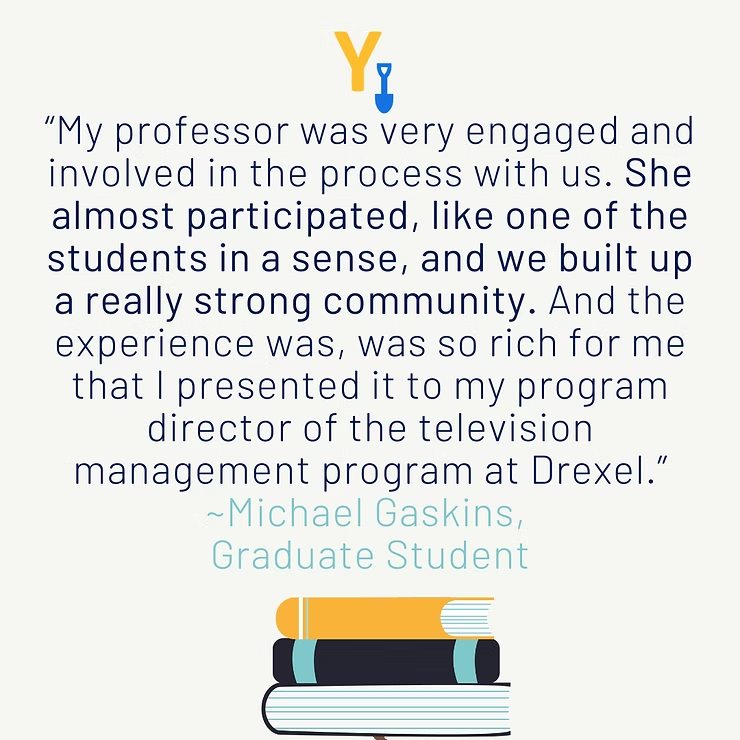
As Michael highlights in the quote below, it is not just the students who make it feel like a community. Some of the best and most impactful relationships that students form in college are with their professors.
Advice for professors from students:
You should allow students to use Yellowdig in multiple ways:
1) To post content that relates to the class that we bring from external sources and may not relating directly to a prompt.
2) “Threads that are about support in general, rather than necessarily specific to that week’s topic.”
3) Encourage student to “get to know each other on a more personal level and, and be supportive peers to one another.” – Pallas, University of Vermont
“Had my professor gone through and read and given me a thumbs up, or a like, or whatever it might be, then it kind of gives me that extra umph, like, wow, the professor’s really paying attention, I’m going to engage, I’m going to make sure that I put forth my best foot because they really are reading this.” – Anthony, Arizona State University
As a professor, you should also create posts that students can interact with. – Ian, University of Rochester
What do students think the role of the professor should be in a Yellowdig community?
The consensus from the panel was, as Anthony shared above, it is not expected for instructors to read and interact with every student’s post. However, the students were all delighted whenever a professor took the time to even simply put a reaction on their post. This acknowledgment makes the student realize that you care and gives them a boost of confidence.
However, as a STEM student, Pallas brings up a good point, “I really think it’s important [for a professor] to be active if there’s a help forum. Because what I’ve seen in a few cases, when I’ve had professors who are not as engaged, is that someone will post a question because they don’t understand something on a problem set, and other students will jump in with their thoughts. And if the last thought on that thread, or the general consensus of whoever is responding is not correct. And it just sits there, it kind of makes the class feel like that is the correct answer.”
To hear a deeper discussion on the role of the instructor, you can listen to our office hours discussion dedicated to that exact topic.
Yellowdig’s patented point system: yay or nay?
Michael shared his thoughts, “I love it. It just makes things that much easier. Whereas with other platforms, you would just have to keep track of that yourself. Yellowdig automatically keeps track of it for you.”
Take a listen to Pallas’s analysis of the point system from her point of view in the clip from the student panel webinar below.
As Pallas shares, the point system’s simplicity is a huge benefit when used for the right purpose. We don’t recommend using Yellowdig for every aspect of your course. For example, if there is a core concept that you need students to prove proficiency in, a quiz or exam is likely better suited. However, Yellowdig is idea for seeing where most of the class is at with a certain topic based on their questions and ability to have thoughtful conversations around that topic (as easily sorted by topic tags). It is also ideal for tracking participation easily and fairly, while building community for your class.
An attendee asked: As a student, how does Yellowdig compare to other platforms like Microsoft teams?
Ian shared his thoughts, “The one thing that I particularly don’t like about Microsoft Teams, at least the way we used it, was that there were so many different folders and different things where you could put different pieces of content. And so I always found myself kind of getting lost. Maybe my high school teacher just didn’t label things correctly, or whatnot. But I just personally did not like the platform as much as I did Yellowdig. Which Yellowdig, like we’ve discussed, there is that news scrolling feature with all the posts and things like that. And also makes it a lot easier for students to keep account of their grades, like we were talking earlier with the word count for your various posts or comments, etc.” We are extremely thankful to the students for their participation in this panel discussion. The insights that students share are extremely valuable and help us to grow and improve. Click on the button below to see the full recording of the webinar and hear the students’ answers to some additional questions like: “What did you not like about Yellowdig?” “How Yellowdig has helped you either personally or academically, during the pandemic?” and “How can professors improve the skills of students with this tool?”
Please reach out to [email protected] if you have any questions about this blog post or Yellowdig in general!